
Ghost Jobs Are Real — And You've Probably Applied to Dozens
The job that was never real. The interview that was never going to happen. The silence that was the plan all along.

The 3 A.M. Question
It's 3 a.m. You've just hit "Submit" on your 47th job application this month.
You spent 40 minutes tailoring your resume. You rewrote your cover letter for the fifth time. You answered 18 screening questions, re-typed your entire work history into a clunky portal, and uploaded the same PDF the portal already had.
Then… nothing.
No "thank you" email. No rejection. No interview. Just silence. The posting stays up for weeks. Then months. You start to wonder: Was anyone ever actually reading these?
Here's the uncomfortable truth: maybe not. That job might never have existed at all.
Welcome to the world of ghost jobs — and once you learn how they work, you'll never look at a "We're Hiring!" banner the same way again.

So… What Exactly Is a Ghost Job?
Let's keep it simple.
A ghost job is a job posting for a role that the company has no real plan to fill. The company is real. The logo is real. The job looks real. But nobody is actually getting hired.
The U.S. Congressional Research Service put it plainly in 2025: a ghost job is an online posting for a position that either does not exist, or that the employer is not planning to fill anytime soon.
There are a few flavors of ghost job:
- The "Always Open" Listing — a posting that's been live for 6+ months and never closes.
- The "Already Filled" Trap — the role was filled weeks ago, but the ad stays up to keep collecting resumes.
- The "Dream Pipeline" — the company isn't hiring now but wants a stack of resumes "just in case."
- The "Pure Theater" — the role never existed. It's there to make the company look like it's growing.
The scary part? You usually can't tell the difference from the outside. You just apply, hope, and wait.
The Numbers Are Genuinely Shocking
Take a breath, because this is where it gets wild.
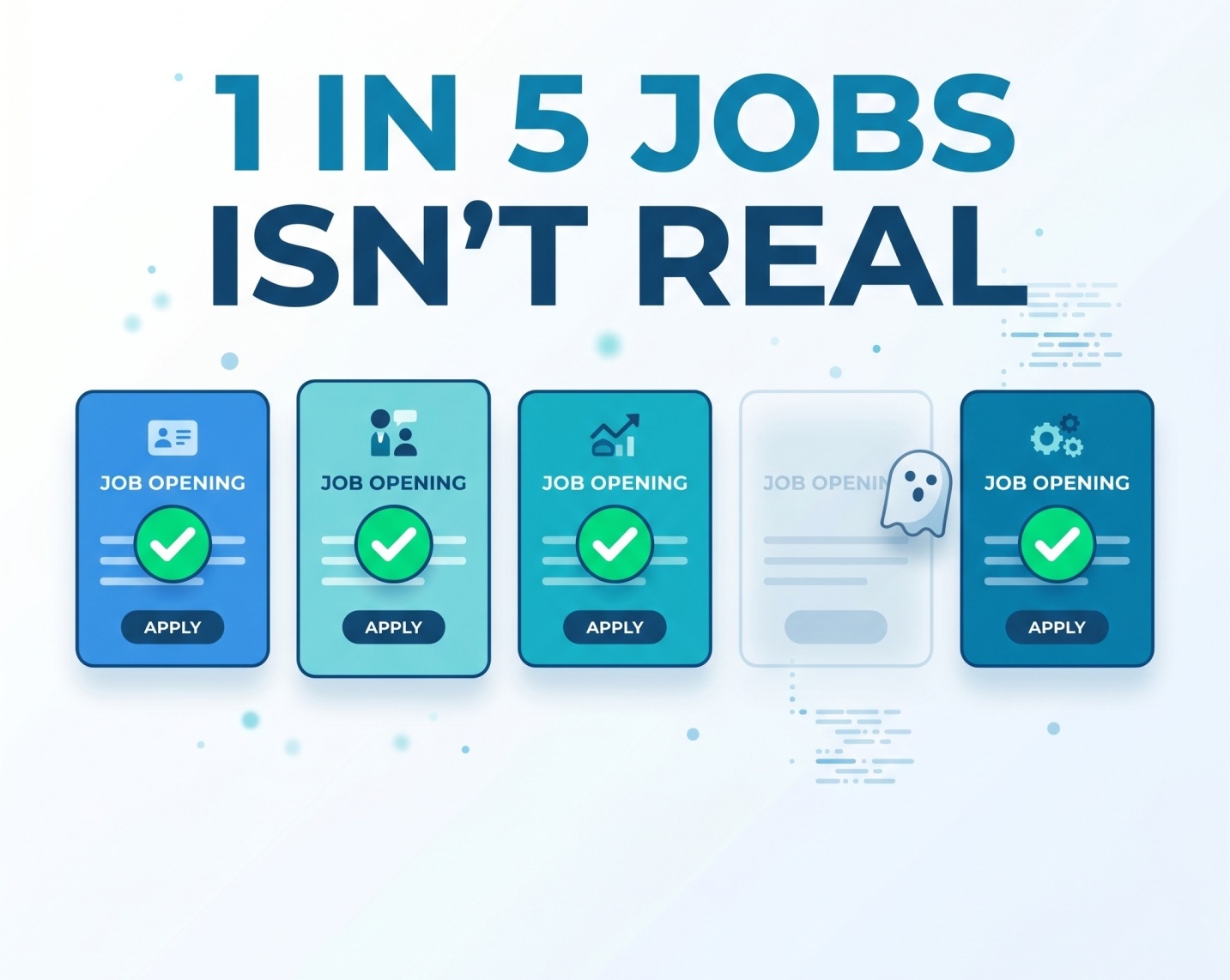
According to a 2025 Greenhouse study, somewhere between 18% and 22% of all online job postings are ghost jobs. That's roughly one in five.
But other research goes even higher. A 2025 analysis of LinkedIn listings by ResumeUp.AI found that 27.4% of U.S. job postings were likely ghost jobs — more than one in four.
And here's the part that should make your jaw drop. A LiveCareer survey of 918 HR professionals (March 2025) found:
- 45% of HR pros said they post ghost jobs "regularly."
- 48% said they do it "occasionally."
- That's a combined 93% who admit to the practice.
- Only 2% said they never do it.
Read that again. Ninety-three percent. When you apply for a job online, the odds that it isn't real are not small — they're built into the system.
The Controversial Part: WHY Do Companies Do This?
This is where the story turns dark. Because some reasons are boring and harmless. And some are… disturbing.
The "innocent" reasons 🙂
Surveys (including a major MyPerfectResume / Resume Builder report) found companies post ghost jobs to:
- Stay visible on job boards (about 38%) — so they look active even when they're not hiring.
- Test their job descriptions (about 36%) — to see what wording attracts talent.
- Build a "talent pool" for the future (about 26%).
- Spy on the market (about 26%) — to see who's applying and what competitors offer.
Okay. Slightly shady, but you can almost understand it.
The reasons that should make you angry 😡
Now hold on, because this is the controversial heart of the story.
The same research found that companies also post fake jobs to:
- Make their current employees feel replaceable. A 2024 Resume Builder report found a startling share of companies — reportedly around 62% — posted ghost jobs specifically to send a message to their own staff: "See all these applicants? You're easy to replace. Don't ask for a raise."
- Trick overworked employees into believing help is coming. Burned-out teams see "We're hiring 6 new people!" and keep grinding — but the company only has the budget (and intention) for one, if any.
- Gauge how hard it would be to replace certain workers (about 25%).
Let that sink in. Some of these fake jobs aren't even aimed at you, the applicant. They're a psychological weapon pointed at the people already inside the building.

Who Are the Worst Offenders?
Not all companies — or cities — are equally guilty.
By company size
Mid-to-large companies (roughly 1,001 to 5,000 employees) are the worst offenders. For these firms, ghost jobs can make up nearly 25% of their postings — concentrated heavily in tech, software development, and publishing.
By city
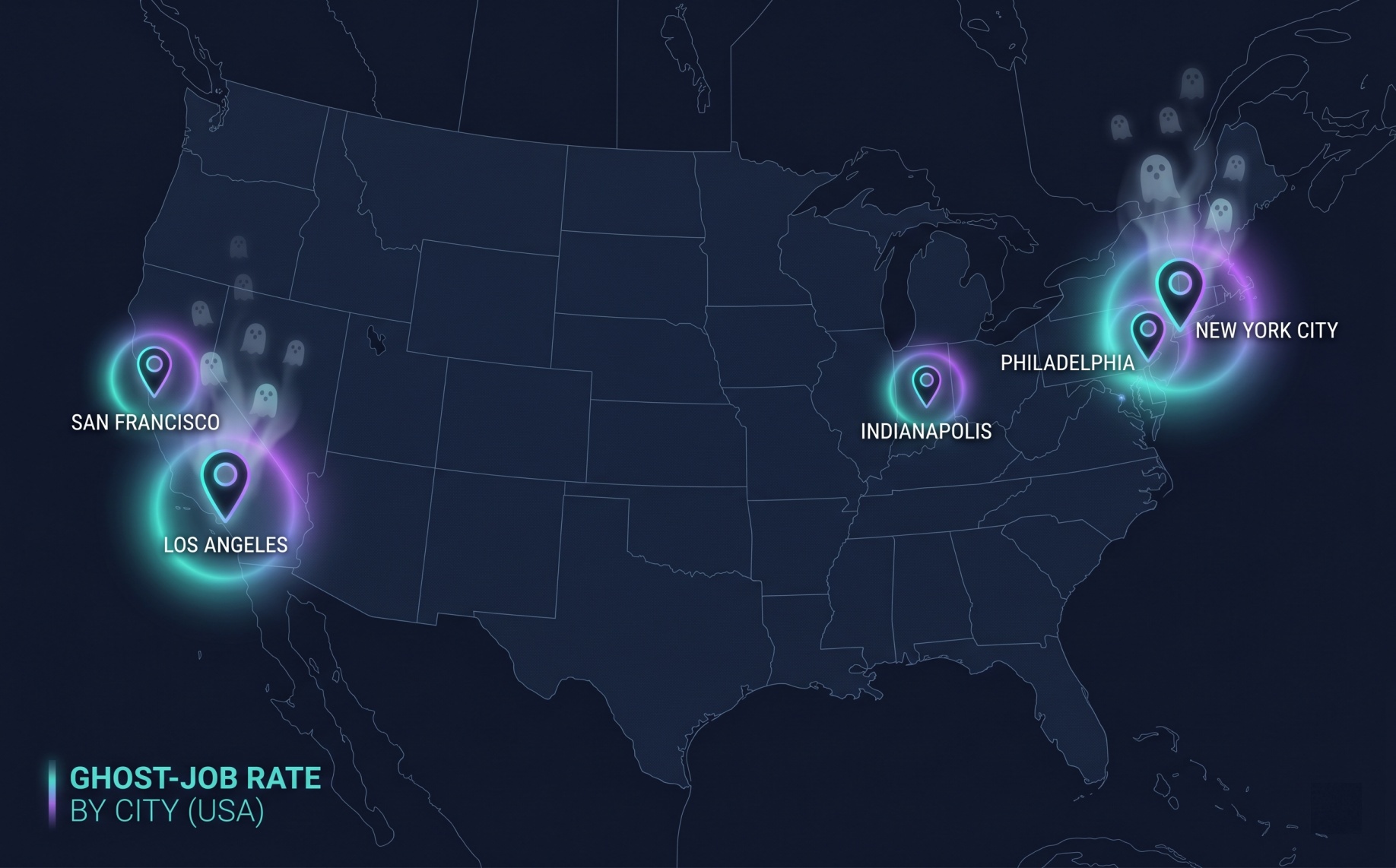
A LinkedIn-based analysis ranked U.S. cities by their share of suspected ghost jobs:
| Rank | City | % of Listings That Are Likely Ghost Jobs |
|---|---|---|
| 1 | Los Angeles | 30.5% |
| 2 | Philadelphia | 30.1% |
| 3 | Indianapolis | 27.8% |
| 4 | New York City | 26.7% |
| 5 | San Francisco | 26.0% |
| … | … | … |
| Lowest | Seattle | 16.6% |
So if you're job-hunting in LA, nearly one in three listings you scroll past may be a phantom.
The repeat-offender mystery
Here's a chilling detail: research suggests a handful of staffing firms were responsible for over 1.2 million suspicious postings on major job boards. A small number of players are flooding the system — and dragging everyone's hopes along with them.
The Damage Nobody Talks About
Ghost jobs aren't just annoying. They quietly break things — for you, and for the whole economy.
1. They steal your time and your hope
Every evening you spend tailoring a resume for a job that doesn't exist is gone forever. Multiply that across dozens of phantom postings and the cost is brutal. One 2025 analysis found that 67% of applications got completely ghosted — not even an automated rejection. Just silence.
Over time, that silence does something worse than waste hours: it breeds cynicism, anxiety, and burnout. People start to believe the whole system is rigged. And honestly? They're not entirely wrong.
2. They lie to the entire economy
This is the part most people never realize.
Governments and economists use job-opening data to decide whether the economy is healthy. But if 1.3 to 1.6 million of those "openings" are fake (the estimate for July 2025, when official openings hit 7.18 million), the picture is distorted.
A senior partner at Korn Ferry warned that ghost jobs are "muddying the jobs report" — making it harder for the Federal Reserve to read the economy and set interest rates correctly.
Think about that. Fake job ads might be quietly influencing the interest rate on your mortgage.
3. The "phantom gap" is huge
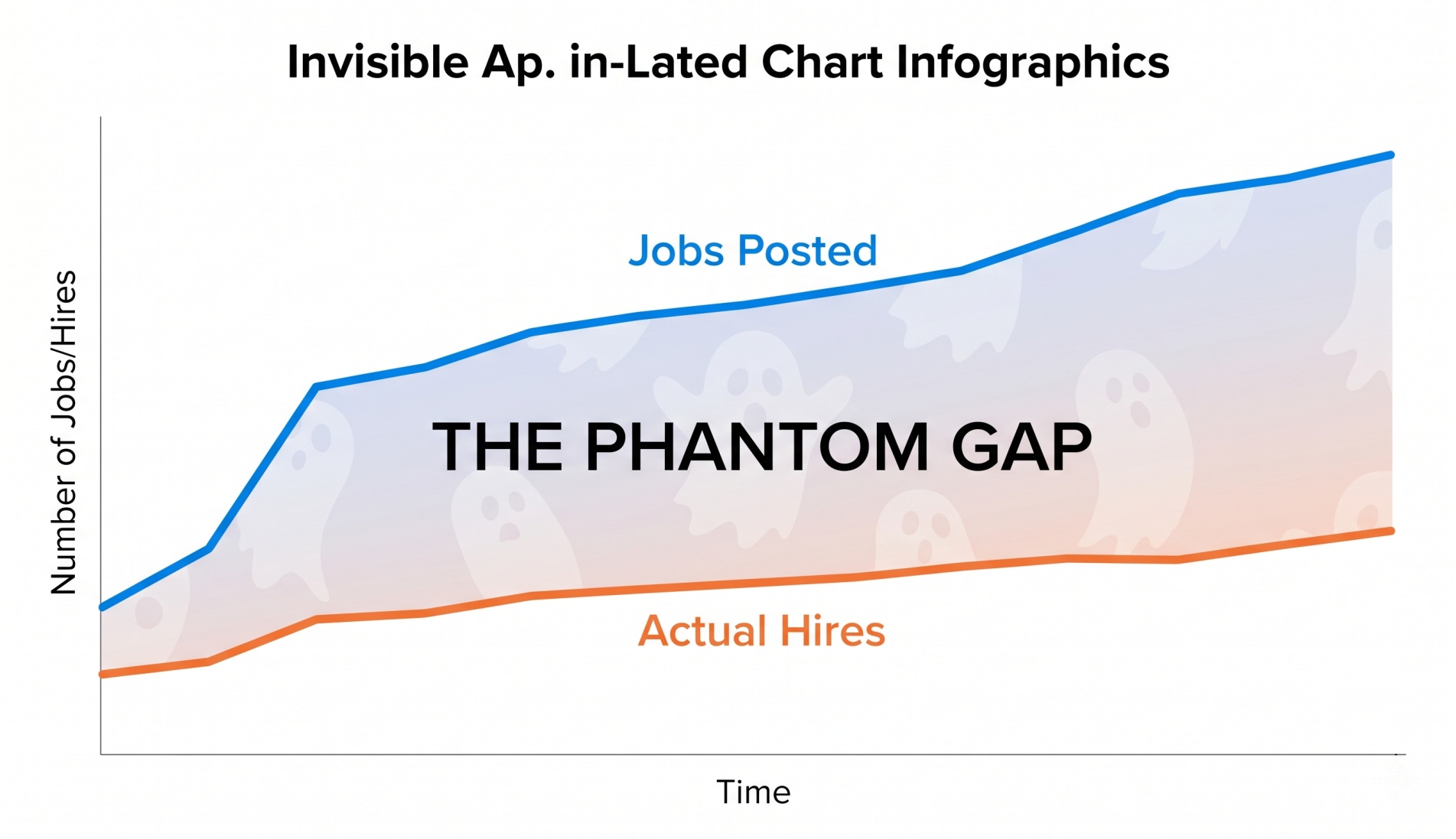
Analysis by MyPerfectResume found that around 30% of job openings never result in a hire — that's over 2.2 million roles a month that exist only on paper. The worst sectors:
- Government: ~60% never filled
- Education & Health: ~50%
- Information / Tech: ~48%
- Financial activities: ~44%
The Fightback Has Begun
Here's the hopeful turn in the story. People are getting angry — and laws are starting to change.
One frustrated engineer vs. the system
Meet the lone advocate. A network engineering leader in Virginia got so fed up with fake job ads that he started a working group with seven others to push for a federal law banning ghost jobs. As he put it, there's currently nothing illegal about posting a job and never filling it — and it's "really hard to prove," which is exactly why it sits in a legal grey zone.
Their proposed federal bill (the TJAAA) would:
- Ban advertising jobs the company has no intention or funding to fill.
- Stop companies posting a role more than 90 days before they actually plan to hire.
- Kill "perpetual" postings that never close.
- Require employers to keep a clear record of where a job is advertised.
States and countries are moving fast
- New York: In April 2026, the state Senate passed a bill (39–19) requiring job ads to disclose if and when the company actually intends to hire.
- Kentucky: HB 342 directly targets "ghost jobs."
- New Jersey & California: Have their own transparency proposals in motion.
- Ontario, Canada: As of January 1, 2026, some companies must tell applicants where they stand — effectively banning interview ghosting and discouraging fake postings.
- The FTC: Reports of job and employment scams nearly tripled from 2020 to 2024, and a federal Joint Labor Task Force is now paying attention.
The grey zone is shrinking. Slowly — but it's shrinking.

How to Spot a Ghost Job Before You Waste Your Time
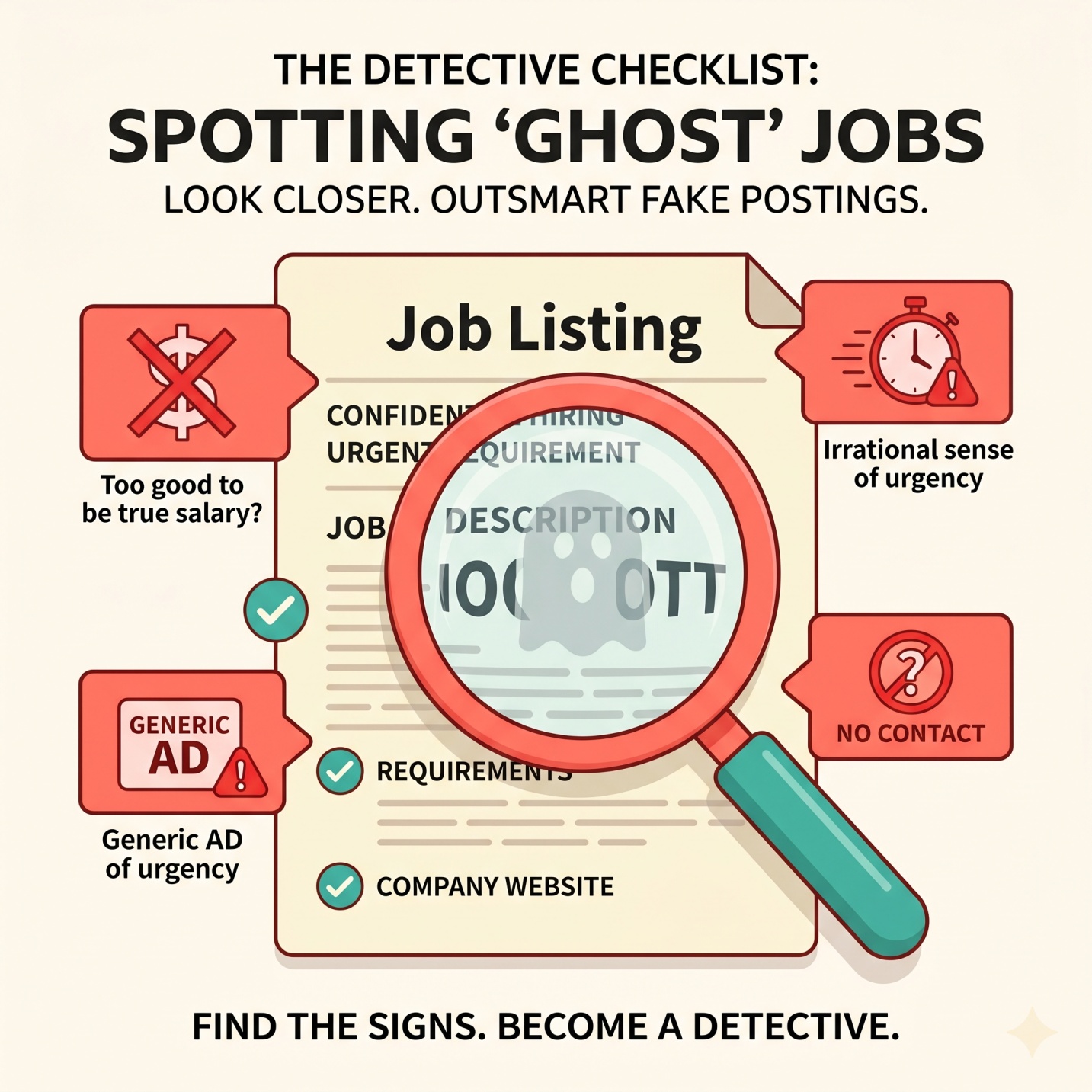
You're not powerless. Before you spend 40 minutes on an application, run this quick checklist. If a posting trips 3 or more of these alarms, be very careful.
- It's been live for 30+ days and still "actively hiring." 🚩
- The exact same job keeps getting reposted every few weeks. 🚩
- No salary range (especially in states that legally require one). 🚩
- Vague, generic description that could fit any company. 🚩
- No named hiring manager or team anywhere. 🚩
- The company just announced layoffs but is "hiring aggressively." 🚩
- It asks for tons of personal data before you can even see details. 🚩
- "Always accepting applications" language — a classic resume-harvesting line. 🚩
Pro moves:
- Check the company's own careers page — if the role isn't there, be suspicious.
- Search the job title + company on LinkedIn to see how long it's really been up.
- Message a recruiter or employee directly and ask if the role is actively being filled.
- Track your applications in a simple spreadsheet so you can spot serial repost offenders.
The Bottom Line
Ghost jobs aren't a glitch. They're a feature of a hiring system where it costs companies almost nothing to leave a fake posting up — and where some firms actively benefit from your wasted hope.
The numbers don't lie: roughly one in five to one in four job listings may not be real. 93% of HR professionals admit to playing the game. And some of those fake jobs exist purely to make real human beings feel small.
But here's the thing — knowing is your superpower. You now understand the trick. You can spot the red flags. You can stop pouring your energy into phantoms and aim it at the roles that are actually real.
And slowly, lawmakers from New York to Ontario are dragging this shadowy practice into the light.
So the next time a job goes silent, remember: it might not be you. It might be a ghost. 👻

📌 Quick-Share Summary (for social captions)
- 👻 1 in 5 (maybe 1 in 4) job listings may be fake.
- 🤯 93% of HR pros admit to posting ghost jobs.
- 😡 Some companies use them to make employees feel replaceable.
- 📉 Fake jobs are distorting the entire economy — even Fed decisions.
- ⚖️ New York, Kentucky & Ontario are fighting back with new laws.
- ✅ Learn the 8 red flags and stop wasting your time.
Sources referenced for this analysis include the 2025 Greenhouse Candidate Experience study, the LiveCareer March 2025 HR survey (918 respondents), ResumeUp.AI's LinkedIn analysis, MyPerfectResume's "ghost job economy" report, Resume Builder / MyPerfectResume employer surveys, the U.S. Congressional Research Service brief on ghost job postings (2025), reporting from CNBC, Fortune, Entrepreneur and Bloomberg Law, and U.S. Bureau of Labor Statistics openings data. Figures vary by methodology and source; treat percentages as informed estimates, not precise universal truths.