
The Last Ones Standing: 10 Jobs AI Won't Take From You in the Next 10 Years
And why most "future-proof career" lists you've read are lying to you.
Let's be honest about something uncomfortable first.
Every year, some analyst releases a report saying "65% of jobs will be automated by 2030." Then another analyst says "AI will create more jobs than it destroys." Both are technically right. Both are also missing the point entirely.
The real question is not will your job exist. It's will your job pay the same, require the same skill level, and give you the same leverage it does today?
That's a very different conversation. And most career advice content doesn't want to have it — because the honest version is complicated, slightly alarming, and doesn't fit neatly into a motivational LinkedIn post.
This one will.
Before The List — The Criteria (This Matters)
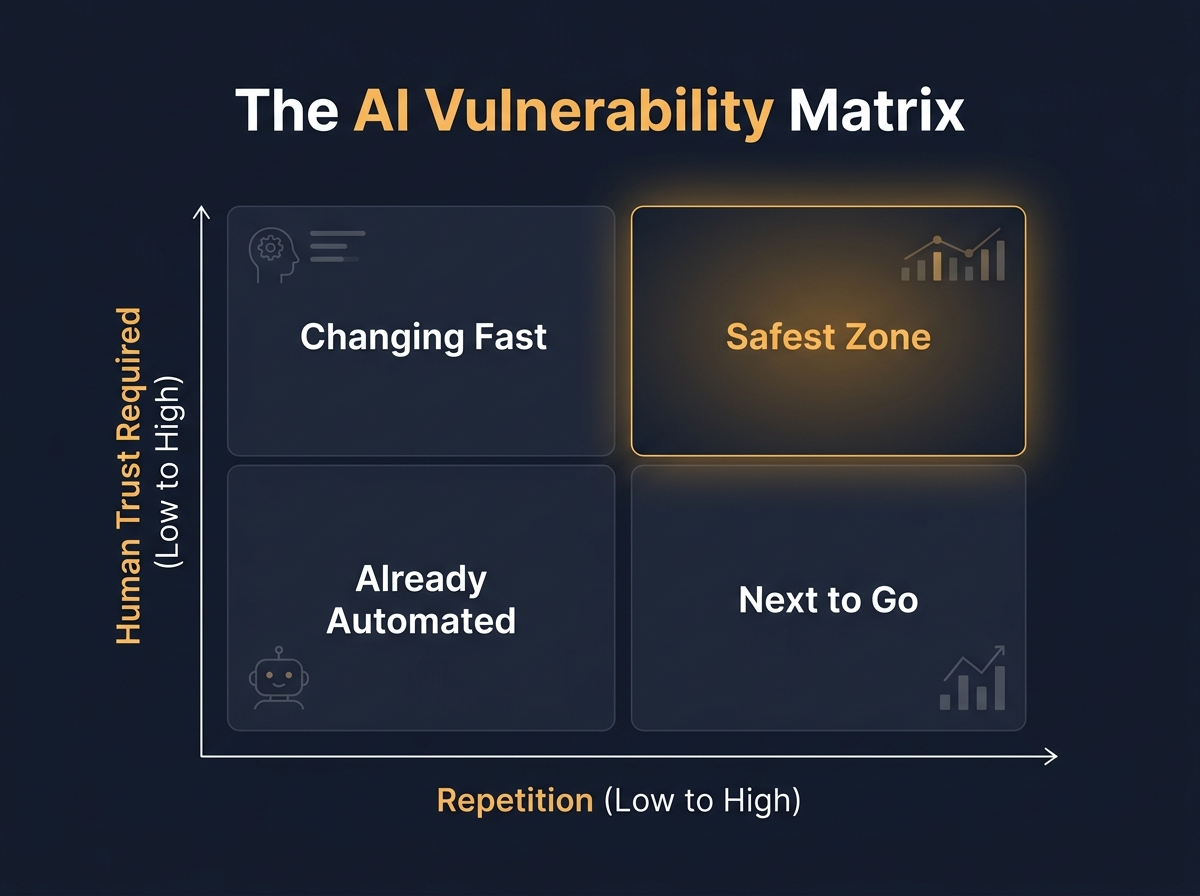
We're not guessing here. The jobs below score high on at least three of these factors:
High physical-world unpredictability — environments that change every single day, where no two situations are the same.
Deep relational trust — work where the human being on the other side needs to feel heard, seen, or genuinely cared for.
Complex ethical judgment — decisions where being wrong has legal, moral, or irreversible consequences.
Creative synthesis under pressure — not just producing output, but adapting in real time when the context shifts.
AI can be trained on all of these. But training on something and doing it reliably, cheaply, at scale, without catastrophic failure? That's a 10+ year problem. Possibly longer.
1. Mental Health Therapist & Counsellor
The one job where "I understand" means everything — and nothing if it's not human.
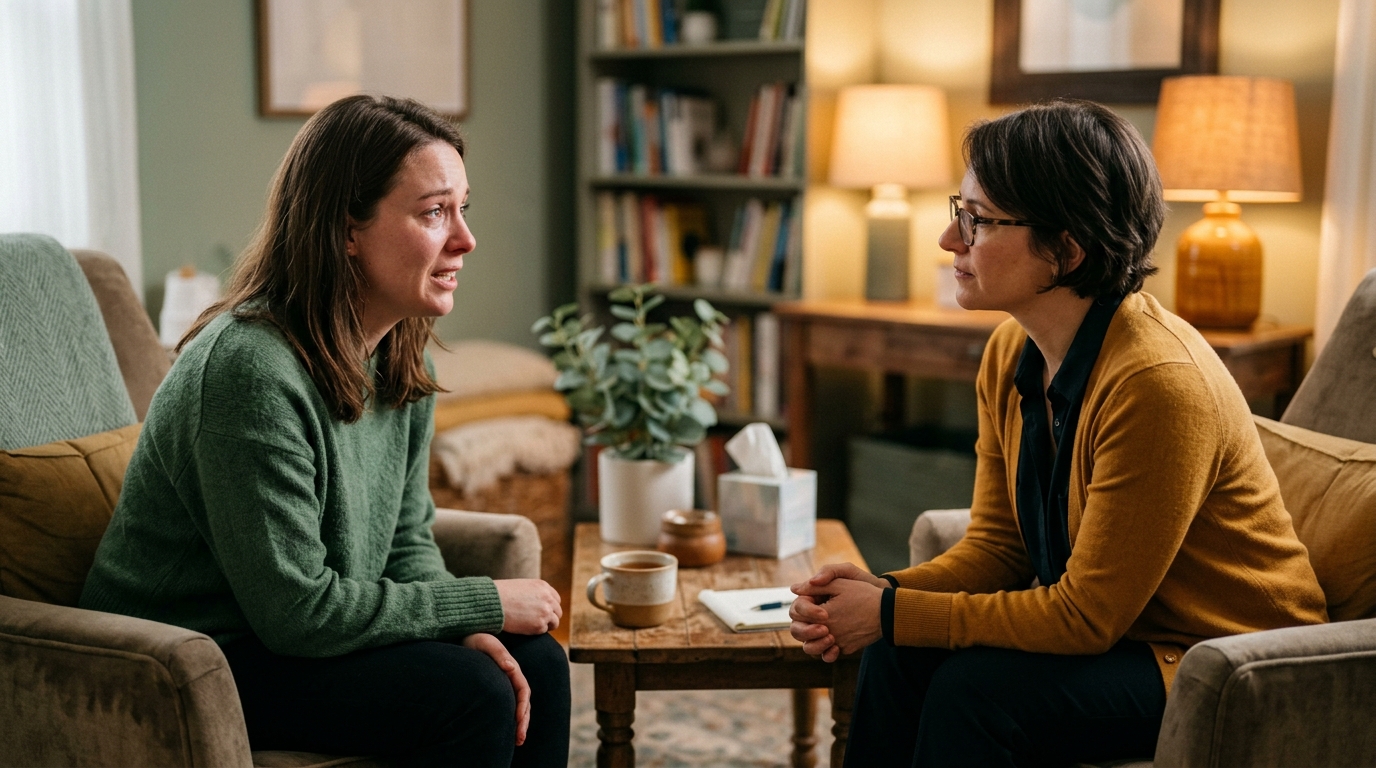
There are already AI therapy apps. Woebot has been around since 2017. Replika became a cultural conversation. And yes, for some people, talking to an AI about anxiety is better than talking to no one.
But here's what those apps can't do: sit with someone in silence. Read the micro-expression that contradicts what the patient just said. Or make the call — the genuinely hard, consequence-heavy call — that someone is a risk to themselves.
Mental health work is not about dispensing information. It's about being present in a way that creates safety. That is a profoundly human act.
The demand side is also only going up. Post-pandemic, the global mental health crisis is very real and very underfunded. There are not enough therapists in most countries, including India. AI won't replace therapists here — it'll become a tool that helps therapists see more patients.
What to do now: Build clinical hours, not just credentials. The relationship skill is the moat.
2. Skilled Trades — Electrician, Plumber, HVAC Technician
The controversial one. Stick with us.
Every tech founder loves to say "learn to code" or "go into AI." Almost none of them say "become an electrician." That's the tell.
Skilled trades are genuinely hard to automate. Not because they require creativity or empathy — though adaptation is very much part of the job — but because the physical world is chaotic. Every house is wired differently. Every pipe layout is unique. Robots that do physical work in unstructured environments are still incredibly expensive, brittle, and slow.
Boston Dynamics has been working on this for 15 years. Their best humanoid robot can open a door. Your plumber can snake a drain in a 100-year-old apartment building while navigating a ladder, a confused homeowner, and a leaking pipe they didn't know about when they walked in.
The income angle is also being quietly suppressed in mainstream career advice. In the US, experienced electricians make $80,000–$120,000 a year. In India, an AC technician with their own operation can clear ₹8–12 lakh without a degree. The "prestigious" software job is getting harder to land and more replaceable. The HVAC job? The robot is simply not coming for it in 10 years.
Uncomfortable truth: Society trained a generation to believe physical work is beneath them. That bias is going to cost a lot of people.
3. Nurse & Paramedic
The reason hospitals haven't automated out nurses despite trying for 30 years is not budget. It's complexity.
Clinical judgment in real-time emergency settings is one of the hardest things to replicate. A paramedic arriving at an accident scene has to process a dozen unstable variables simultaneously — the patient's breathing, their position, the crowd around them, the information a panicked bystander is giving incorrectly — and make a decision in 90 seconds that could kill someone if wrong.
AI can assist here. It already does, in some diagnostic tools. But assist is not replace. The liability alone makes autonomous clinical decision-making a legal and ethical minefield that no hospital system is willing to cross in the foreseeable future.
Nursing, specifically, also involves physical care that is deeply intertwined with dignity. Bathing a patient, repositioning someone in pain, holding a hand in an ICU — these are not tasks. They're acts. And they require a human being.
4. Trial Lawyer
AI can write a contract. It cannot look a jury in the eye.
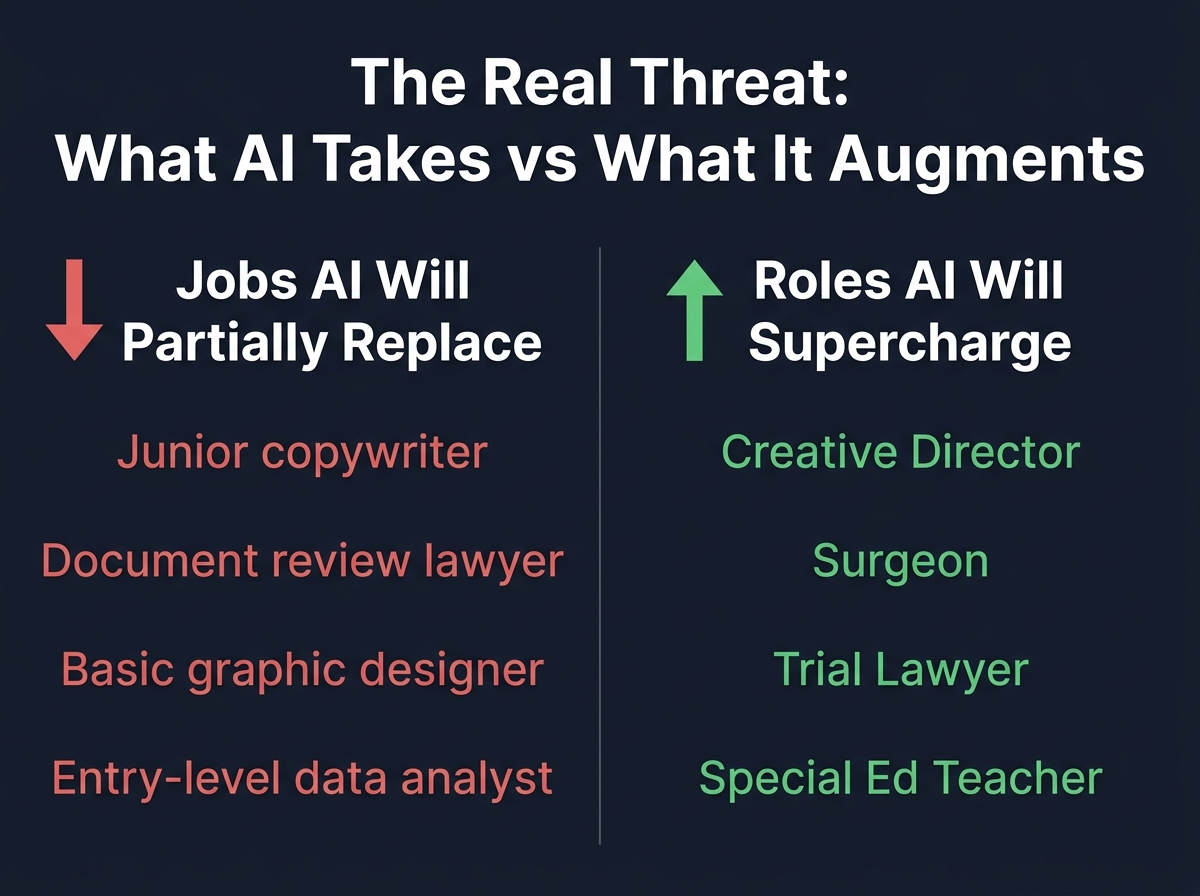
Legal work is already being disrupted. Contract review, legal research, due diligence — these are going to AI fast, and that's not controversial. Junior lawyers doing document review are in real trouble.
But trial law? Criminal defense, personal injury litigation, anything that ends in a courtroom?
That's a performance. A human performance, built on years of reading people, understanding narrative, and making split-second calls based on how a witness shifts in their seat. No model is trained for that. No model is allowed to do that, in any current legal framework.
There's also the adversarial dynamic. In a trial, you are not just generating output — you're responding to another human who is actively trying to defeat you. That real-time adaptive combat, with enormous stakes, is something AI assists with but cannot own.
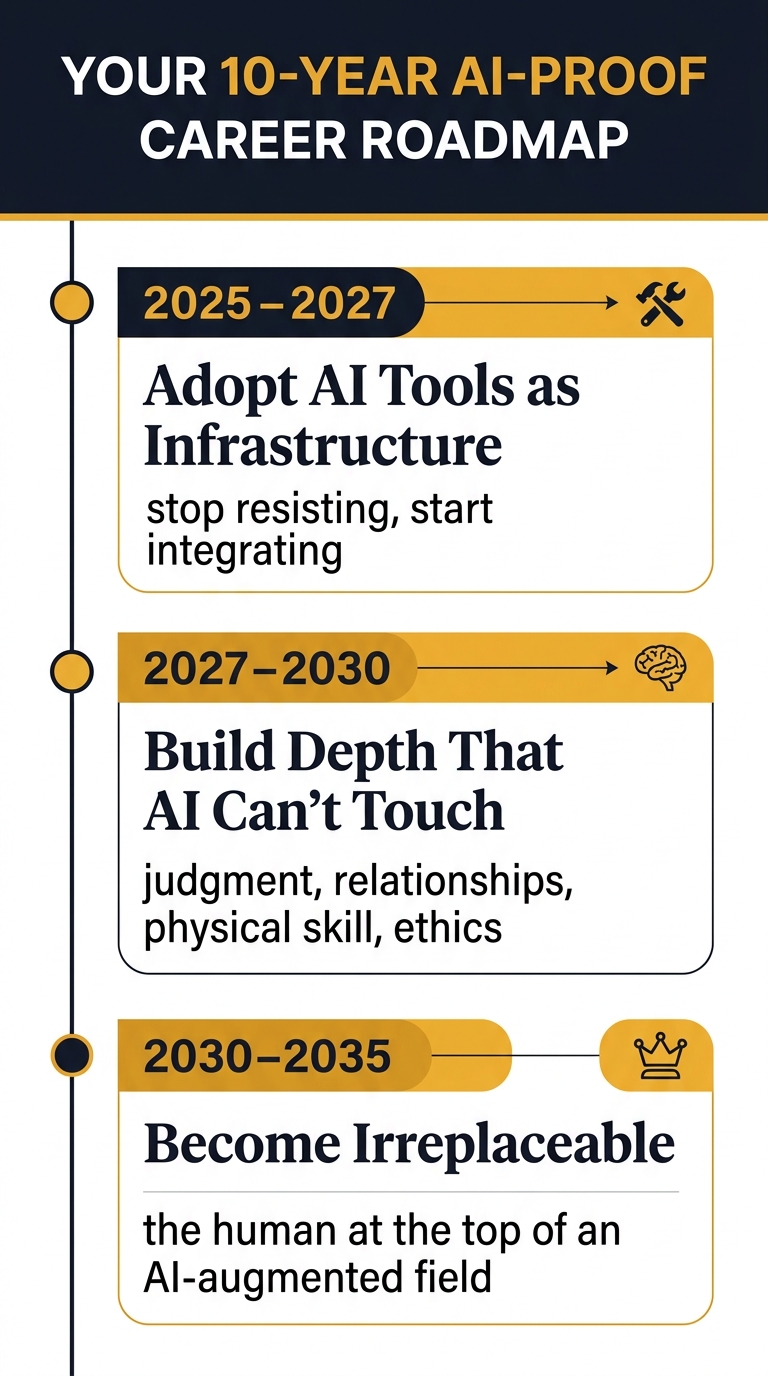
The nuance: Lawyers who don't adopt AI tools will be outcompeted. Lawyers who become AI-native will be very hard to replace.
5. Special Education Teacher
This one barely ever makes these lists. It should be at the top.
Teaching in general is at medium risk. A lot of content delivery, assessment, and even feedback can be AI-assisted or partially automated. That shift is already happening.
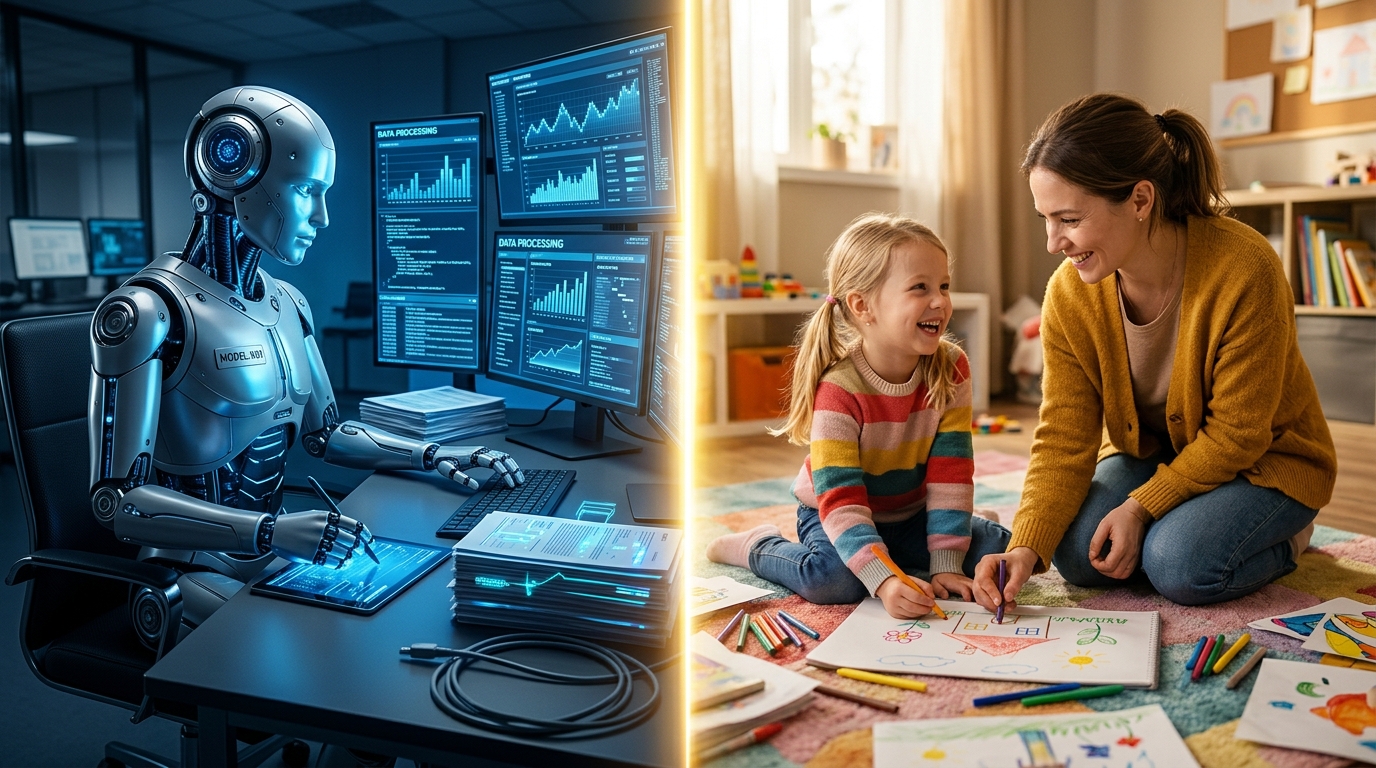
Special education is different. Children with learning differences, disabilities, or developmental conditions require teaching that is radically personalized — not just in content, but in emotional approach, pacing, sensory awareness, and trust-building over months and years.
A student with severe autism requires a teacher who notices a change in body language before the student can even communicate what's wrong. That requires human presence, human consistency, and human relationship. An AI tablet is a tool in that classroom. It is not the teacher.
Demand is also structurally underfunded and understaffed globally. This is not a job that risks being over-automated. It risks continuing to be under-resourced while everything around it gets fancier.
6. Social Worker
One of the most underpaid, undervalued, and un-automatable jobs in existence.
Social workers operate at the intersection of human crisis, institutional bureaucracy, and ethical complexity. They make decisions about whether a child is safe at home, whether an elderly person needs removal from their environment, whether someone in addiction is ready for intervention.
These decisions carry life-altering consequences. They require empathy, legal knowledge, local context, and a kind of moral courage that has to be earned through experience. Not generated from training data.
The reason AI won't take this job is the same reason no one has fully automated a judge: the accountability has to live with a human being. Someone has to be answerable. And that person, for now, is a social worker.
7. Surgeon (Especially Complex or Emergency Procedures)
Here's where the list gets controversial.
AI-assisted surgery is real and growing. The da Vinci surgical system has done millions of procedures. Imaging AI is diagnosing cancer earlier than humans can. This is not hype — it's happening.
So why is surgery on a safe jobs list?
Because assisted and replaced are not the same thing. The surgeon is still in the room. Still making calls. Still holding the legal and moral responsibility for the outcome. AI is the instrument, not the surgeon.
The harder point: fully autonomous robotic surgery at scale requires solving problems in motor control, real-time adaptation to unexpected anatomy, and regulatory approval that is still a decade away in most healthcare systems. And for complex cases — trauma surgery, unusual presentations, anything that doesn't match the training data — a human is still better.
Surgeons who resist AI tools will struggle. Surgeons who master them will be nearly impossible to replace.
8. Creative Director (Not Just "Creative")
A distinction that the industry desperately needs to make.
This is the most nuanced entry on the list, so pay attention.
AI will displace a huge portion of execution-level creative work. Junior copywriters, stock illustrators, basic video editors — that disruption is already underway. If your value is in producing creative output, you are at risk.
A Creative Director's value is different. It's in judgment. Knowing that the campaign direction is off before seeing a single asset. Understanding the cultural context that makes a tagline land or bomb. Reading a client's nervousness in a meeting and knowing the work needs to shift before anyone has said anything explicitly.
That kind of synthesis — business strategy, cultural literacy, brand intuition, human psychology — is not something a model learns from a dataset. It's something a person develops over 10 years of being wrong, getting feedback, and trying again.
The Creative Director who knows how to use AI will produce work ten times faster than before. That person is not replaceable — they're more valuable.
9. Research Scientist (Especially Field Research)
The counterintuitive one.
At first glance, AI seems like an existential threat to research. It can process literature, generate hypotheses, run simulations, write papers. DeepMind's AlphaFold solved protein folding — a problem that took biologists decades. This is real.
But here's what's being missed: AI accelerates research by automating the parts that were bottlenecks. The direction of research — what questions to ask, why they matter, what the ethical implications are — that's still human.
Field researchers face an additional layer of protection. Ecological fieldwork, archaeological excavation, anthropological study — these require physical presence in environments that are, by definition, not digitized. You can't train a model on a species that hasn't been catalogued yet. Someone has to go find it.
The scientists who adopt AI as infrastructure — for literature synthesis, data processing, modeling — will do in two years what used to take ten. Those are the ones who flourish.
10. Crisis Negotiator
The rarest job on this list. Also possibly the safest.
Crisis negotiation — hostage situations, suicide intervention, high-stakes standoffs — is a discipline built entirely on one thing: establishing trust with a person who has decided to stop trusting the world.
It requires real-time reading of vocal tone, emotional escalation, and psychological state. It requires the negotiator to be genuinely present, because the person on the other side can often sense inauthenticity. It operates in environments with zero margin for error, no script that works twice, and outcomes that are literally life or death.
This job will not be automated. Not in 10 years. Not in 20. The day we trust an AI to talk someone down from a ledge is the day we've made a collective decision about what we think human life is worth.
Until then, this is one of the most protected careers in existence — and it is hiring.
The Honest Conclusion Nobody Wants to Write
Here's the thing about AI and jobs that most content dances around:
AI is not going to create a clean divide between "safe" and "automated" careers. What it's actually going to do is compress the middle. The people at the top of every field — the ones with genuine judgment, real relationships, hard-won expertise — will be fine. Actually, they'll be better off, because AI will eliminate the junior competition and give them tools that multiply their output.
The people in the middle — doing work that's "good enough" but not exceptional, relying on institutional process rather than personal skill — those are the ones who should be worried.
This is a harder story to tell than "just learn Python" or "go into healthcare." But it's the true one.
The question isn't which jobs are safe. The question is: are you the kind of person in that job who cannot be replaced?
That answer has nothing to do with AI.
Key Takeaways at a Glance
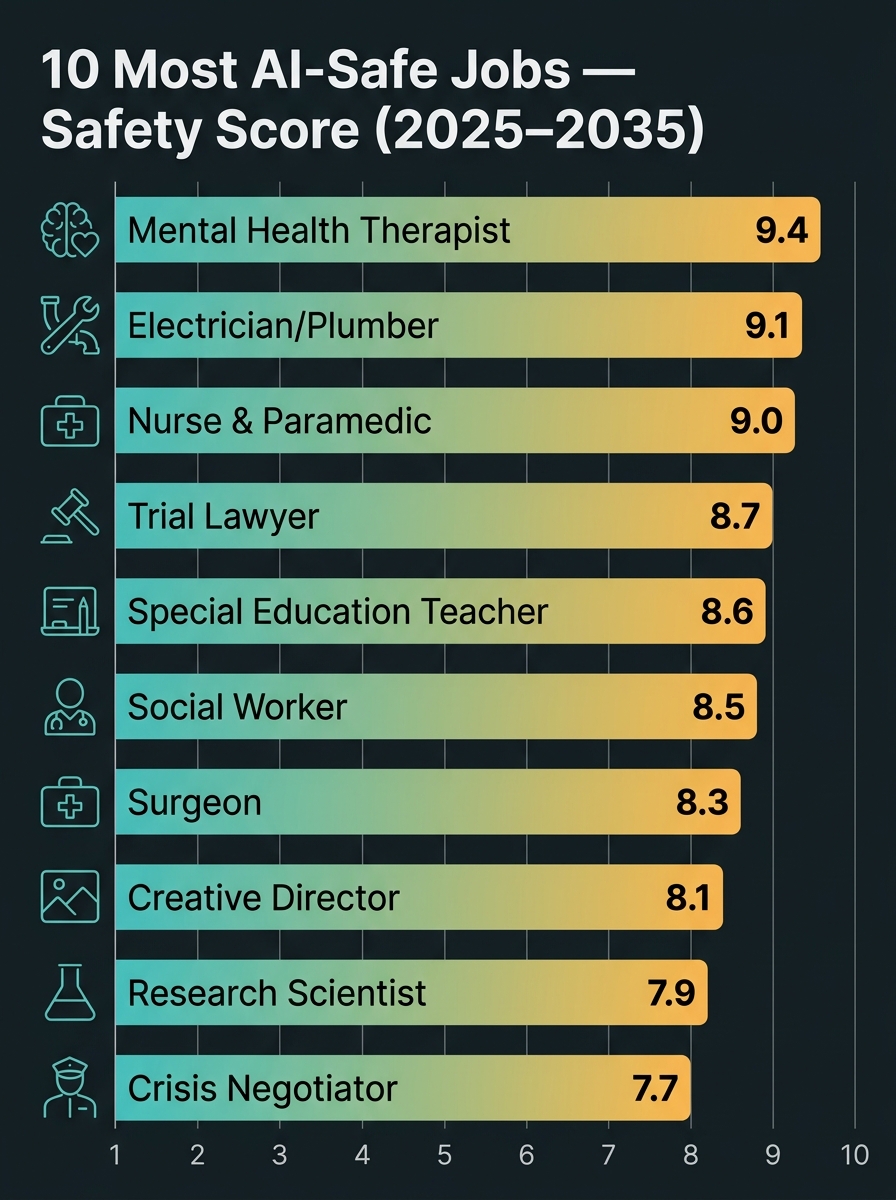
| Job | Core Protection | AI's Role |
|---|---|---|
| Mental Health Therapist | Human presence & trust | Scheduling, note-taking |
| Electrician / Plumber | Physical unpredictability | Diagnostics assist |
| Nurse & Paramedic | Clinical judgment + care | Monitoring, data flags |
| Trial Lawyer | Courtroom performance | Research, drafting |
| Special Ed Teacher | Deep personalization | Content delivery |
| Social Worker | Ethical accountability | Case documentation |
| Surgeon | Adaptive surgical judgment | Precision instruments |
| Creative Director | Strategic cultural intuition | Asset generation |
| Research Scientist | Question formation + fieldwork | Data processing |
| Crisis Negotiator | Real-time human trust | None credibly yet |
Resume built for the future? Nord Resume helps you position yourself for the jobs that matter — with formats that actually get read.
Build Your Resume on Nord Resume →
Sources & further reading: McKinsey Global Institute (2023 Automation Report), World Economic Forum Future of Jobs Report 2023, Bureau of Labor Statistics Occupational Outlook, MIT Work of the Future Task Force, Oxford Martin Programme on Technology and Employment.